Lab Ready
A chemical safety onboarding course for new lab technicians
Portfolio concept · Built and published in Articulate Rise 360
- Audience
- Newly hired adult lab technicians, from career changers to experienced techs, and the supervisors who onboard them.
- Problem
- A 70-rule safety contract that people skim, sign and forget, with facts that didn't match Cal/OSHA.
- My role
- Sole designer and developer: source review, objectives, wireframes, Rise 360 build, job aid and evaluation plan.
- Constraint
- Every rule had to match Cal/OSHA §5191, and experienced hires needed a way to test out.
- Outcome
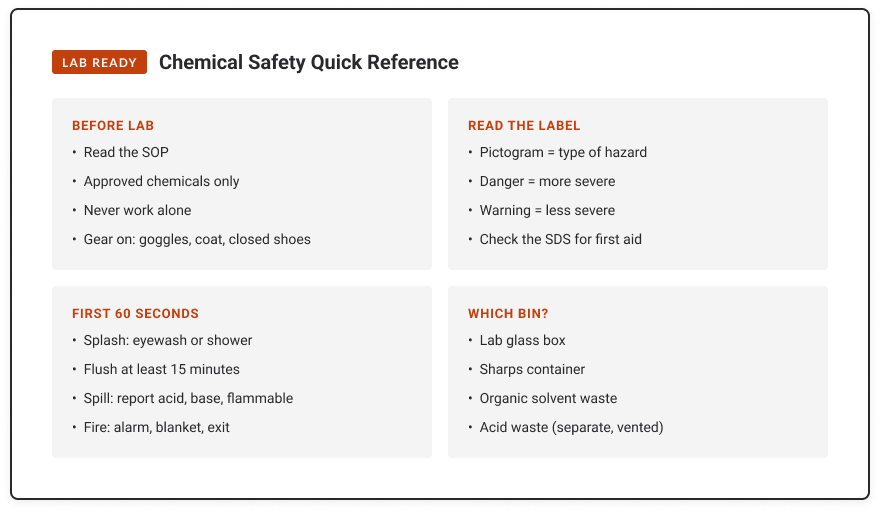
- A published Rise 360 course that turns about 70 rules into 7 practiced decisions, plus a one-page bench job aid.
Lab Ready is a scenario-based onboarding course that turns a 70-rule chemical safety contract into seven decisions new lab technicians actually face: reading a label, checking a fume hood, knowing when to clean up a spill and when to call for help, and leaving a station safe for the next person. I designed it for adult learners and built and published it in Articulate Rise 360, with practice in every lesson and a job aid that stays at the bench.
Lab Ready is a concept course and hasn't been delivered to learners yet. I adapted the source documents without naming the school district or university they came from.
My process
From problem to prototype
Compared the safety contract I handed my own students with Cal/OSHA §5191 and a university Chemical Hygiene Plan, and found where they disagreed.
See it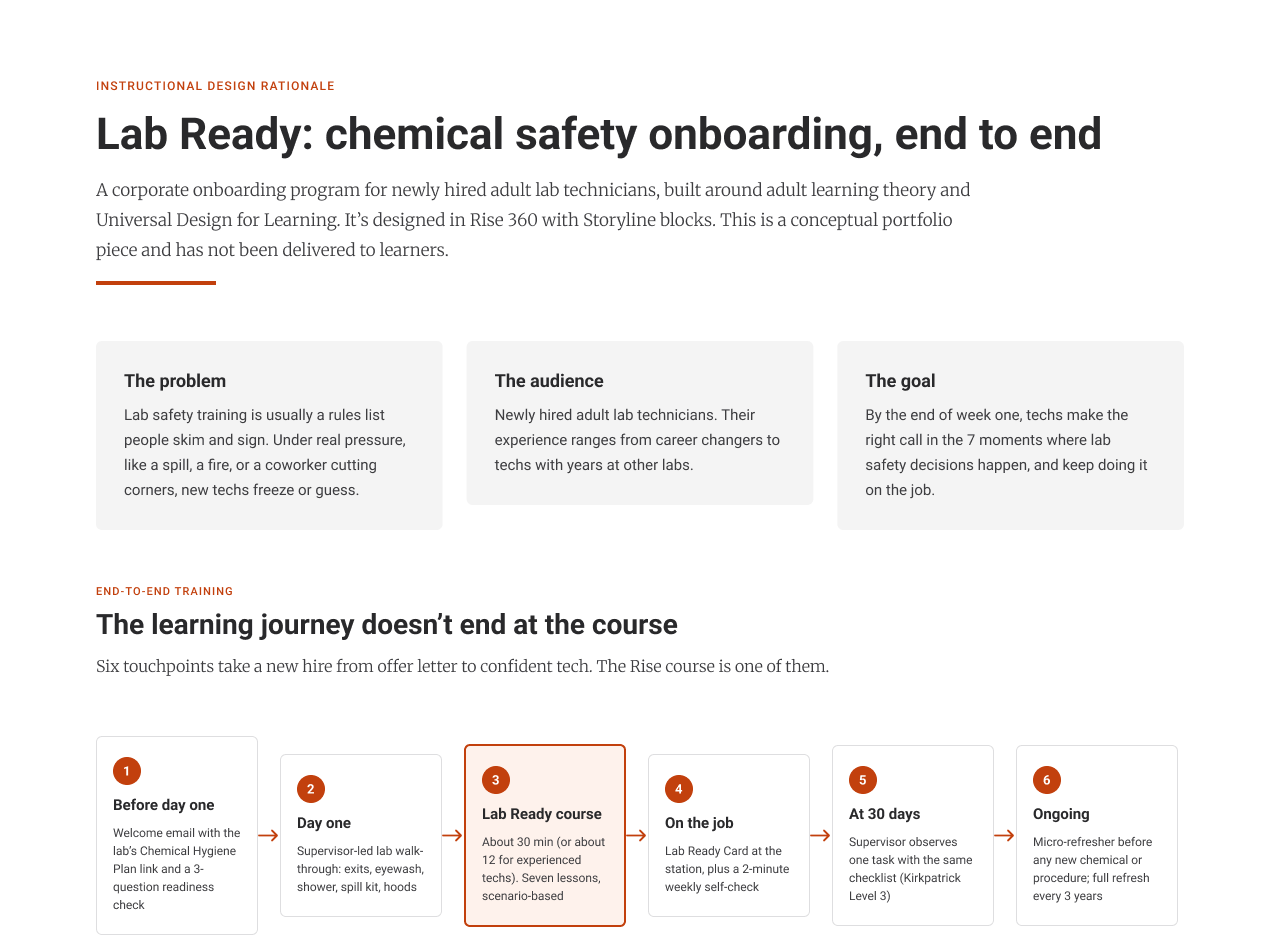 Design
Reorganized about 70 rules into 7 decision moments, wrote objectives, and planned a 6-touchpoint training journey.
See it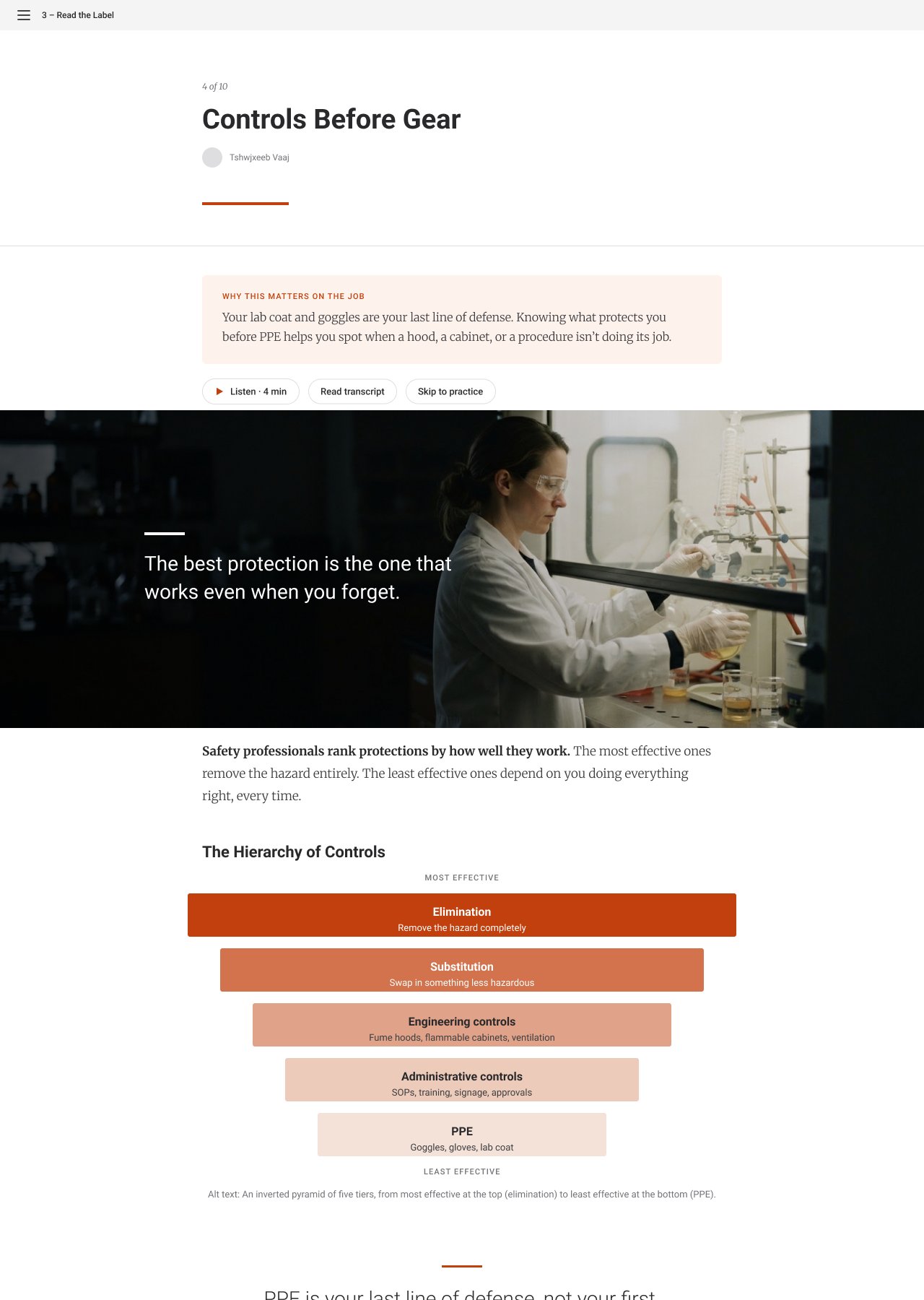 Develop
Wireframed every lesson first, then built and published the course in Articulate Rise 360.
See it EvaluatePlanned all four Kirkpatrick levels, from a usefulness rating to a 30-day supervisor check.
See itThe Problem
In college chemistry labs and in my own classroom, safety came the same way: pages of rules and dense bullet points, signed and filed away. I handed out that kind of contract to my own students, about 70 rules across two pages. People skim, sign and forget, and a list of rules doesn't tell you what to do when a spill is too big, a hood alarm goes off, or a senior coworker cuts a corner.
The Solution
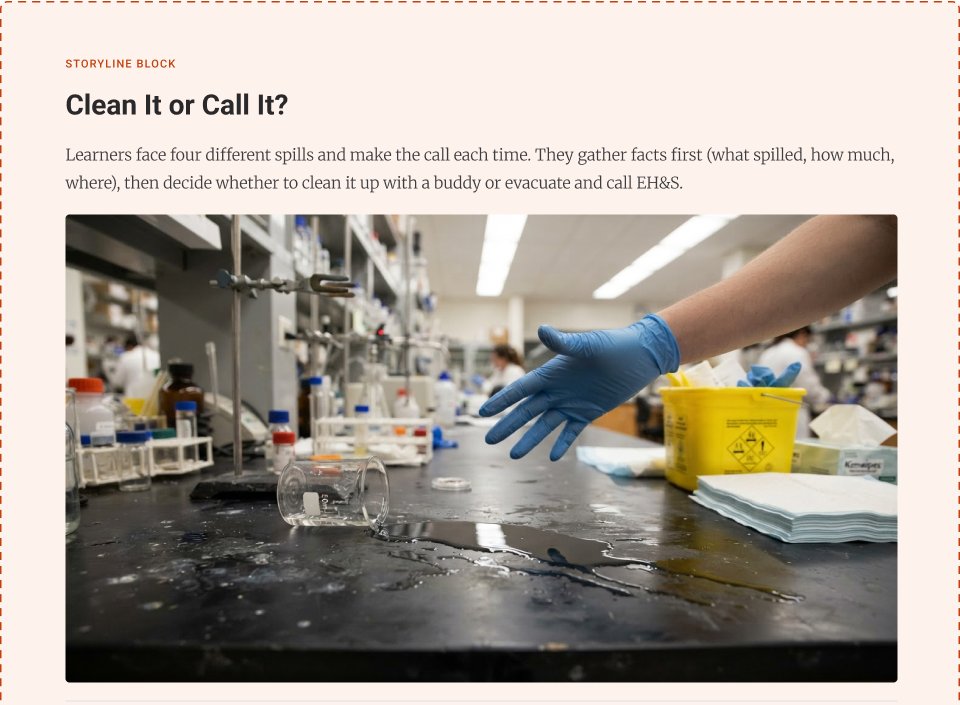
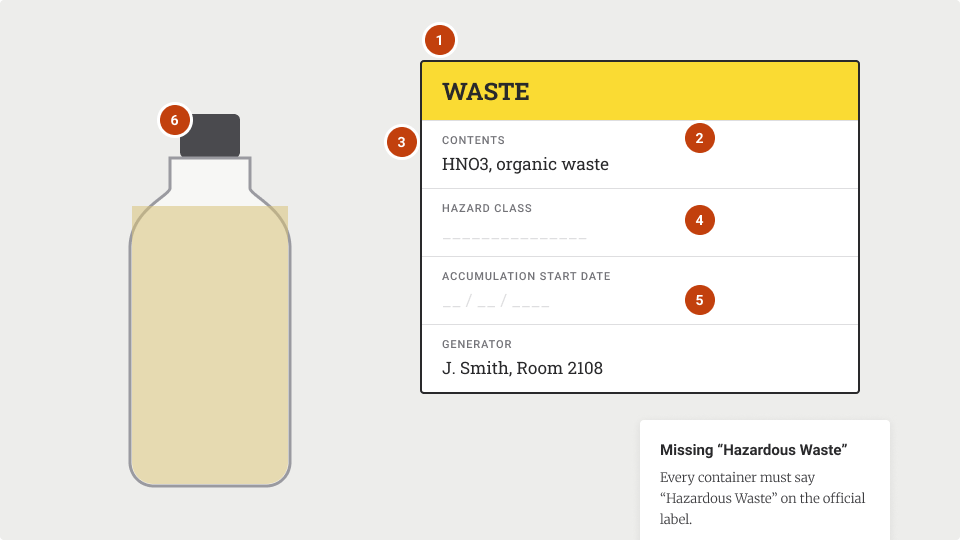
I take complex information, like long regulations and pages of bullet points, and turn it into scenarios people can actually practice. Here, I rebuilt the rules around the moments new technicians face. Each lesson opens with why it matters on the job, teaches one decision, and gives practice right away: a fume hood to inspect, spills to clean up or call in, a waste label to fix. Experienced hires can test out, and everyone leaves with a one-page card for their station.
Learning objectives
What learners will be able to do
Given a real task at the bench, a new lab technician will be able to:
- 01
Read a chemical label and Safety Data Sheet to name a chemical's hazards before using it.
Measured by: the label and hazard questions in the final check.
- 02
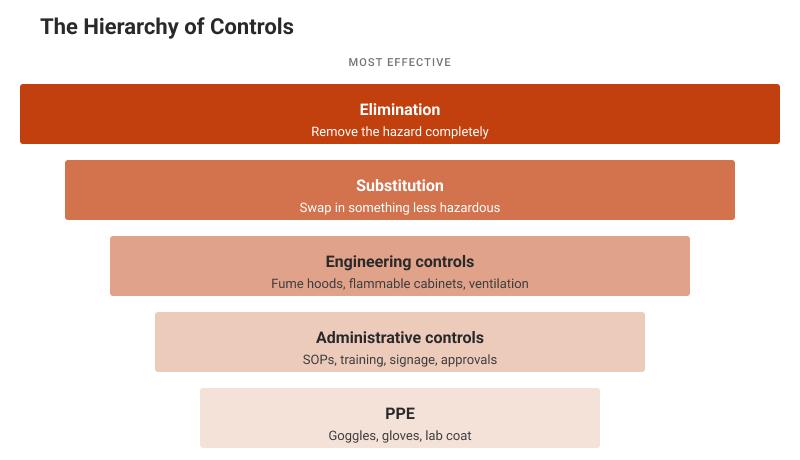
Check a fume hood and choose the right controls and protective gear for a task.
Measured by: finding the problems in Hood Check, plus the glove question.
- 03
Decide whether to clean up a spill or call for help.
Mastery: the right call in all three Clean It or Call It? scenes.
- 04
Respond to a splash, a fire or an unknown chemical in the first 60 seconds.
Measured by: the fire and old ether bottle scenarios.
- 05
Label and sort hazardous waste, and leave the station safe for the next person.
Measured by: all six errors found on the waste label, plus the container sort.
Each objective maps to one of the seven decision moments and a section of the Lab Ready Card.
My thought process
How the design evolved
Lab Ready grew out of problems I've seen myself, as a chemistry student, in the lab, and in my own classroom. Here's the path, in order.
Start in the lab
I've spent years in chemistry labs, first as a college chemistry student and then as a chemistry teacher. Safety was always handed over the same way: long documents, dense bullet points, and a signature at the end.
Notice the gap
Knowing the rules on paper isn't the same as knowing what to do when a beaker tips or a hood alarm goes off. I saw that gap in my own classroom, so I started with the safety contract I gave my students.
Teach it to adults
The same problem follows people into their first lab job. I asked how I'd teach what I taught my students to an adult new hire, someone who brings experience, wants to know why, and needs to use it right away.
Read the real standards
Cal/OSHA §5191 and a university Chemical Hygiene Plan raised the bar and exposed errors: 15 vs. 20 minutes for an eye flush, the outdated term MSDS, and a contact lens rule the adult standard doesn't include.
Turn notes into scenarios
I took pages of regulations and long bullet lists and boiled them down to 7 decisions, each one something learners can practice: a hood to inspect, a spill to clean up or call in, a waste label to fix.
Make it work for real adults
I added a test-out path for experienced techs, a “why this matters” card in every lesson, audio and transcripts, and a 6-touchpoint journey. Then I built and published the course in Rise.
Practice in every lesson
I wireframed every lesson before opening Rise, so each block had a job before I built it. Each lesson reads like a short story: a photo with a caption, a few sentences, then practice. Each lesson teaches one decision and practices it right away.
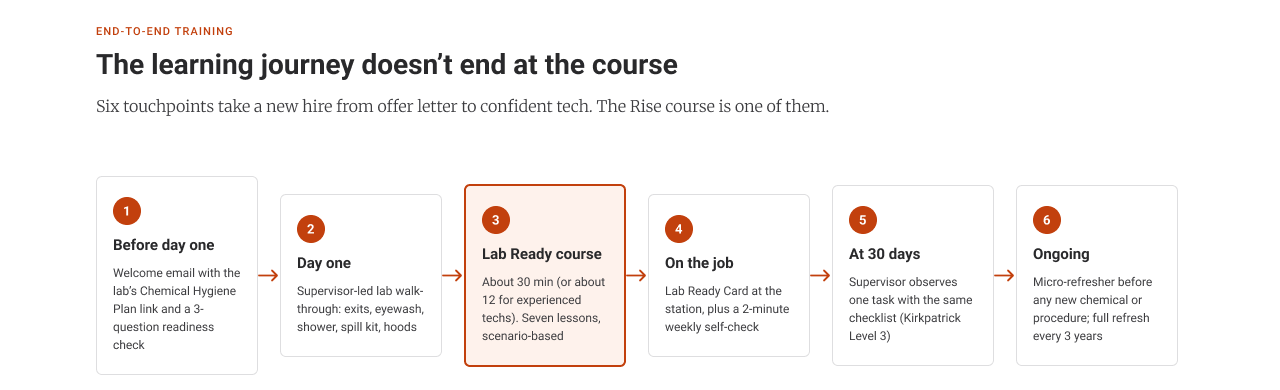
The course is one of six touchpoints
Training doesn't end when the course does. I planned a journey from before day one to a refresher every three years: a welcome email with the lab's safety plan, a day-one walk-through, the course, a station card and weekly self-check, a supervisor check at 30 days, and a short refresher before any new chemical or procedure.
Measuring what matters: Kirkpatrick's four levels
Training only counts if it changes what people do at the bench. Here's how I'd measure Lab Ready with a real group of new hires, from their first reaction to results in the lab.
New techs find it useful for the job.
A 1–5 usefulness rating at the end of the course.
Built into the courseTechs make the right call in each scenario.
A scenario-based final check, 80% to pass, with links back to each lesson.
Built into the courseTechs use the habits at the bench.
A supervisor observes one task at 30 days, using the weekly self-check.
PlannedA safer lab.
More near misses reported, and fewer inspection findings and incidents.
PlannedAccessibility & UDL
Designed so more learners can get in
Built in
- Every hazard pictogram has a text label, so color is never the only cue.
- Audio narration, a transcript and captions are available in every lesson.
- Experienced hires can test out with a short self-check; everyone else follows a guided path.
- No time limit on the final check, and a timer that can be turned off in timed practice.
- Alt text on every graphic, and a click-to-place option for drag activities.
Next accessibility pass
- Check every color pair in the Rise theme against WCAG 2.2 AA contrast.
- Test the full course with a keyboard and a screen reader.
- Rebuild Hood Check and Clean It or Call It? in Storyline with a logical keyboard focus order.
- Publish the Lab Ready Card as an accessible PDF.
Lessons Learned
The biggest lesson was that the source material had problems of its own. The student contract and the adult standards disagreed on simple facts, like how long to flush an eye. Reading the actual regulation, not a summary of it, changed the course.
I also learned Rise by building the whole course in it, from the first block to the published link. Wireframing first meant every block had a job before I opened the editor. Where Rise's built-in blocks couldn't do what I planned for Storyline, I swapped in a labeled graphic and a scenario block, and I noted the Storyline upgrade as the next step.